BFelfluencer: AI-Powered Social Media Engagement Platform
The Problem
The community management team (managing e.l.f. social media replies after content is posted) was chosen to lead a pioneering AI initiative at e.l.f. Despite processing tens of thousands of comments monthly across Instagram, TikTok, paid ads, and user-generated content, the team could only respond to 50% of incoming comments. With replies outsourced to agencies, community management costs exceeded $120,000 per month. The team needed to scale brand engagement while maintaining e.l.f.'s authentic voice and high-quality responses, but manual response management was time-consuming, expensive, and limited their ability to engage with the community at scale.
The Solution
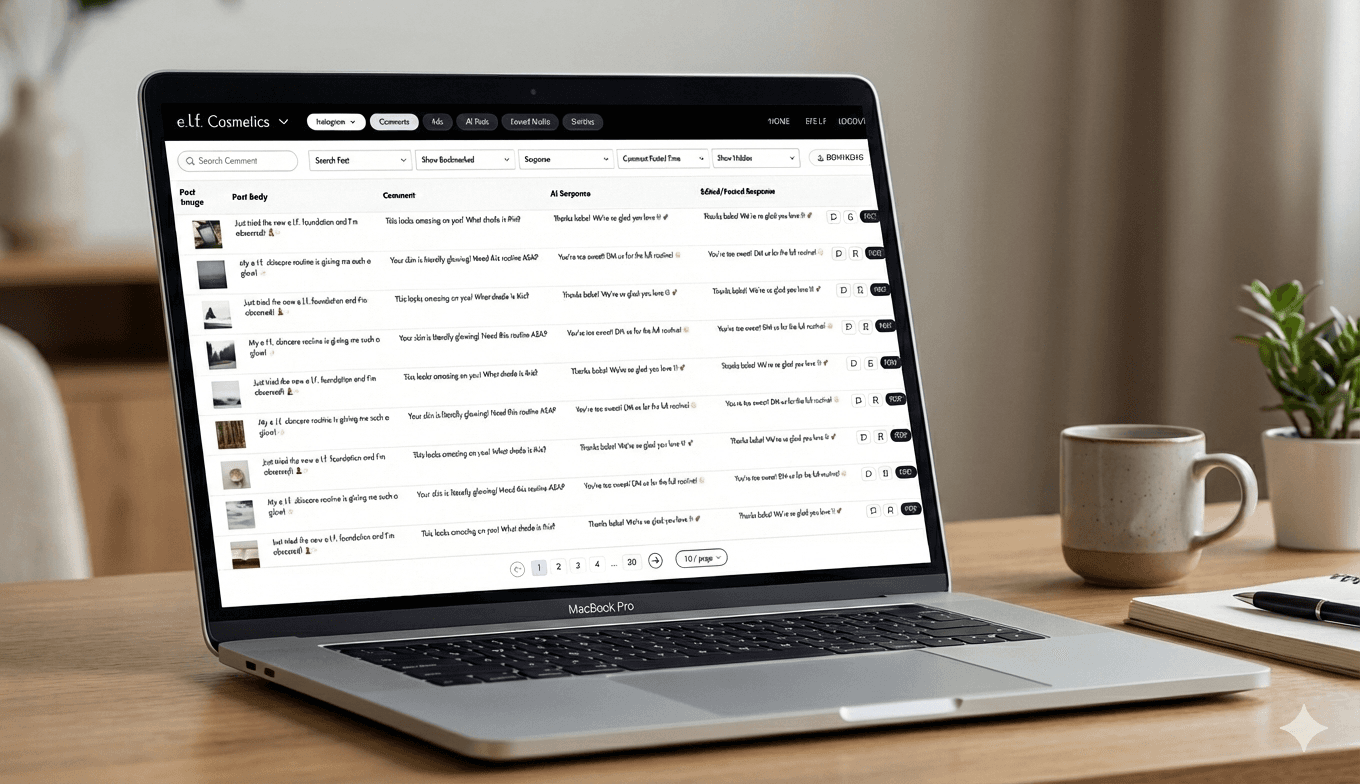
Built BFelfluencer, an AI-powered platform that uses LLM technology to generate contextual, brand-aligned responses. The platform provides suggested replies that the community management team can approve, regenerate, or edit manually, creating an efficient human-in-the-loop workflow. The AI was trained on e.l.f.'s brand voice and tone, ensuring consistency across all channels.
Impact
AI-generated responses achieved the same quality ratings as human-edited responses, validating the platform's effectiveness. The team was able to scale engagement significantly while maintaining brand voice consistency. However, the project revealed important insights about AI adoption, crisis preparedness, and the need for clear success metrics.
Design Process
Research & Discovery
Analyzed community management team workflows, identified pain points in manual response management, and researched AI/LLM capabilities for brand voice consistency
AI Model Training
Trained LLM on e.l.f.'s brand voice, tone, and existing high-quality responses to ensure generated replies matched brand standards
Workflow Design
Designed approve/regenerate/edit workflow that balanced automation with human oversight and control
Platform Development
Built unified interface integrating owned social channels, paid ads, and UGC into single response management system
Testing & Iteration
Conducted quality testing comparing AI responses to human responses, iterated on model training and workflow based on team feedback
Launch & Rollout
Launched platform with community management team, provided training and support, monitored quality metrics and team adoption
Overview
BFelfluencer was an AI-powered social media engagement platform built for e.l.f. Beauty's community management team. The platform leveraged Large Language Model (LLM) technology to help the team analyze and respond to comments and replies across e.l.f.'s owned social media channels, paid advertising, and relevant user-generated content.
The core innovation was using AI to generate brand-aligned response suggestions that the community management team could review, approve, regenerate, or edit before sending. This human-in-the-loop approach allowed the team to scale their engagement efforts while maintaining control over brand voice and quality.
The Challenge
e.l.f. Beauty's social media presence spans multiple platforms, paid advertising campaigns, and a vibrant community of user-generated content. The community management team faced several critical challenges:
- Volume Overload: Managing thousands of comments, replies, and mentions across multiple channels daily
- Brand Consistency: Maintaining e.l.f.'s authentic, playful, and inclusive brand voice across all interactions
- Resource Constraints: Limited team capacity to respond to every meaningful engagement opportunity
- Quality Standards: Ensuring every response met the brand's high standards for customer service and community engagement
The team needed a solution that could scale their efforts without compromising on the quality and authenticity that made e.l.f.'s social presence so effective.
The Solution
BFelfluencer integrated LLM technology directly into the community management team's workflow. The platform:
AI-Powered Response Generation
The core feature was an LLM trained specifically on e.l.f.'s brand voice, tone, and existing high-quality responses. When a comment or reply needed a response, the AI would analyze the context and generate a suggested reply that matched the brand's style.
Human-in-the-Loop Workflow
Rather than fully automating responses, the platform gave the community management team three options for each AI-generated suggestion:
- Approve: Send the AI response as-is
- Regenerate: Request a new AI-generated response with different tone or approach
- Edit: Manually modify the AI suggestion before sending
This workflow ensured the team maintained control while benefiting from AI efficiency.
Multi-Channel Integration
The platform unified responses across:
- Owned social media channels (Instagram, TikTok, Twitter, etc.)
- Paid advertising comments and replies
- User-generated content mentions and tags
This created a single interface for managing all community engagement, regardless of source.
Results & Impact
Quality Validation
The most significant finding was that AI-generated responses received the same quality ratings as human-edited responses. This validation proved that the AI could effectively capture and replicate e.l.f.'s brand voice, opening the door for scalable engagement.
Scale & Efficiency
The platform enabled the community management team to:
- Respond to significantly more comments and replies
- Reduce time spent on routine responses
- Focus human effort on complex or strategic interactions
- Maintain consistent brand voice across all channels
Team Adoption
The community management team successfully integrated BFelfluencer into their daily workflow, using it to handle a substantial portion of their response volume while maintaining quality standards.
Key Learnings & Challenges
While BFelfluencer achieved its core goals, the project revealed important insights about AI adoption in enterprise settings:
Challenge 1: Trust & Gradual Adoption
Finding: Despite research showing no quality difference, the community management team was hesitant to let AI handle 100% of responses, even for routine interactions.
Insight: Change management is critical for AI tools. Teams need time to build trust with AI systems, even when data supports full automation.
Lesson: Design for gradual adoption. Start with high-confidence scenarios and expand AI autonomy as teams gain confidence. Provide transparency into AI decision-making to build trust.
Challenge 2: Edge Case Training
Finding: The team avoided using the platform (or even manual responses) for difficult situations like spam, hate comments, or negative feedback. This meant the AI never learned to handle these scenarios effectively.
Insight: AI systems need diverse training data, including edge cases and difficult scenarios. Avoiding these cases creates blind spots.
Lesson: Proactively train AI models on crisis scenarios, negative feedback, and edge cases. Build these capabilities before they're needed, not during a crisis.
Challenge 3: Crisis Response Limitations
Finding: When a social media crisis occurred, the team went silent because they couldn't scale responses using the AI platform. The AI hadn't been trained on crisis scenarios, and the team lacked confidence in its crisis-handling capabilities.
Insight: Crisis preparedness requires proactive planning. AI tools need specific training and protocols for high-stakes situations.
Lesson: Build crisis response capabilities into AI systems from the start. Create dedicated crisis workflows, train models on crisis scenarios, and establish clear protocols for when and how to use AI during crises.
Challenge 4: Metrics & Business Value
Finding: Leadership told the team to "respond to as many replies as possible" without clear goals, metrics, or understanding of how engagement translated to business value. The team couldn't demonstrate ROI or optimize for meaningful outcomes.
Insight: Social engagement needs clear KPIs tied to business value. Volume alone isn't a meaningful metric.
Lesson: Define success metrics upfront:
- Engagement Quality: Response quality scores, sentiment analysis
- Business Impact: UTM tracking, conversion attribution, link clicks
- Efficiency Metrics: Time saved, responses per hour, cost per engagement
- Strategic Goals: Brand sentiment, community growth, customer satisfaction
Without these metrics, it's impossible to optimize for what actually matters or demonstrate value to stakeholders.
Technical Approach
The platform integrated LLM technology with e.l.f.'s social media management infrastructure. Key technical considerations included:
- Brand Voice Training: Fine-tuning the LLM on e.l.f.'s existing responses and brand guidelines
- Context Awareness: Analyzing comment context, user history, and channel-specific nuances
- Workflow Integration: Seamless integration with existing social media management tools
- Quality Assurance: Built-in quality checks and brand voice validation
Future Vision
If building this platform again, I would:
- Start with Crisis Scenarios: Train the AI on difficult situations from day one
- Define Success Metrics Early: Establish clear KPIs tied to business value before launch
- Design for Gradual Trust: Create a trust-building journey that starts with high-confidence scenarios
- Build Measurement Tools: Integrate UTM tracking, conversion attribution, and engagement analytics from the start
- Create Crisis Protocols: Establish clear workflows and training for crisis scenarios
Conclusion
BFelfluencer successfully demonstrated that AI can maintain brand voice quality while scaling engagement efforts. The project's challenges revealed important lessons about AI adoption, crisis preparedness, and the critical importance of defining success metrics that connect to business value.
The platform proved that AI-powered tools can be effective partners for social media teams, but success requires thoughtful design, proactive training, and clear measurement of what matters most.